I have arranged priorities in such order:
Peace
Environment
Health
Human rights
Education
Poverty
Corruption
Unemployment
Travel & tourism
"Peace" is on the first place for me, because the third world war would be the last war on the Earth. And I really worry about the conflict in Yugoslavia.
Ilirjan Zulfiu from Macedonia writes: "I have five refugees from Kosovo in my house that are staying with us. They have a little boy with them. I'm deeply moved with one of his reaction. Every time that we eat or drink something he has a plastic bag and he put stuff in there and he says that he is keeping that food for his father because he knows that his father has nothing to eat. I hope that one day he will give that food to his father if he finds him ALIVE. Please report this situation and keep backing up these refugees. You are all they have."
Also, there is a letter from Jelena Sredojevic: "I am writing this letter from Belgrade, in a hope that my words will show what the people in Serbia really think and feel in this moment. This is not a voice of Slobodan Milosevic or another politician, it is a voice of a 20-year-old girl. ... I would like to ask the NATO, can they solve the problem with bombing? Do they know how many civilians will die? Do they know how are the kids feeling, can someone explain them why they cannot go out and play with other kids? How are the pregnant woman feeling in cold and dark shelter ... I would like to send this letter to Slobodan Milosevic, maybe I could wake up his conscience."
Actually, I think first three priorities are integrated. Macedonian environmentalists are reacting with horror against the bombing in Yugoslavia, particularly after reports from Greek researcher, Professor Zeferos who said that bombing in Yugoslavia is a great environmental catastrophe for the entire Balkan region. The Macedonian environmental movement is asking the Macedonian government to react against the NATO bombing of Yugoslavia and help the whole world. Professor Zeferos, an environmental chemist from the Aristotle University of Thessaloniki, says that the first three days of bombing above Yugoslavia released a large amount of hazardous, toxic, carcinogenic and radioactive substances. The biggest fear of possible bombing of power plants by NATO forces, because the public's risk of inhaling highly contaminated air would then be very high. The chief inspector of the Macedonian Ministry of Environment, Miroslav Balaburski, said that furans and dioxins, which are released at the time of the bomb ex
plosions, are being carried for long distances across the planet. Balaburski said that in this process is very often immersion in hazardous substances which endangers public health. Some of these substances released by the bombing deplete the ozone layer, which may widen the ozone hole in the future, Balaburski warned. He said that now the Ministry of Environment does not know which radioactive substances we have in the atmosphere. If anyone knows that, he said, then this information should not be kept as a military secret. From the Center for Radioisotopes, a Macedonian government institution based in Skopje, Zoran Bozinovski said that pollution released by the bombing over Yugoslavia is entering Macedonia by air and by the river Lepenec that crosses the border between Macedonia and Yugoslavia. A chemist from the Center, Ivan Grozdanov, said that when aircraft fuel burns it releases nitrous oxide, which damages the ozone layer with dangerous results for human health. The Montreal Protocol, the International
treaty governing ozone-depleting substances says, "Nitrous oxide is the primary source of stratospheric NOx (Nitrogen oxides), which play a vital role in controlling the abundance of stratospheric ozone." Inspector Balaburski said that of 210 dioxins and furans he knows of, 17 of them are extremely toxic and break down very slowly. Contact with these toxic substances, according World Health Organization, produces nervous system disorders, cancers of the respiratory organs, hepatitis, and fetal deaths, depending on the doses. The Macedonian Minister of Environment, Sokol Klincarov, said he would bring these problems up at the next meeting of SECI, part of the Central European Initiative. He said he believes that kind of discussion could palliate the causes of this pollution. In November 1989 in Budapest, the deputy Prime ministers of Austria, Hungary, Italy, and Yugoslavia established an Initiative for cooperation. The Initiative has now grown to include: the Czech and Slovak Republics, Bosnia and Herzegovina,
Croatia, Slovenia, Macedonia, Albania, Belarus, Moldova, Bulgaria, Romania, Poland and Ukraine. The CEI Secretariat is located in Trieste, Italy. Because members of the CEI come from both NATO and non-NATO countries, it might prove to be an arena for bringing about understanding and cooperation. But, Macedonian environmentalists ask how. They fear the radioactivity on the scale of that released by the Chernobyl nuclear accident in the Ukraine 13 years ago and still felt across Eastern and Central Europe. You can see that "Environment" depends on "Peace". And what will be, if the nuclear war will begin?
 The consequences of a nuclear explosion can be seen on an example of Chernobyl crash. The reactor burned out of control for six days, spewing tons of lethal radionuclides across the surrounding countryside, while the authorities failed to warn people of the dangers and delayed evacuating villages for fear of creating panic. The UN estimates 9 million people have been affected by the Chernobyl disaster in Russia, Belarus and Ukraine. Ups to 200 people were hospitalised due to the radiation exposure. Due to the nature of radiation exposure many of the medical effects may not form until many years after the accident. These medical problems may include cancer, birth defects, and skin diseases. There is an estimate of 6500 people that may die from cancers caused by the radiation. Some 400,000 are refugees, forced at a minute's notice to leave their homes in the 30-kilometer (19-mile) area around the station. They can never safely return. Meanwhile, nearly 1 million peo
ple continue to live in seriously contaminated areas. Their forests and farmlands are poisoned with the radionuclides cesium, strontium and plutonium. The liquidates have since dispersed across the former Soviet Union and their fate is largely unknown. Ukraine has announced that 6,000 of its liquidates died between 1988 and 1994. Vyacheslav Grishin, a liquidator himself who heads the Chernobyl Union of Russia, which helps former liquidators, said one in 25 had died and one in ten was too sick to work. In the village of Chernobyl, 18 kilometres (11 miles) from the plant, firemen were building a monument last week for the anniversary of their colleagues who died. Of 300 volunteers who went into the blast zone on the night of the explosion, 31 died within a week, Grishin said.
The consequences of a nuclear explosion can be seen on an example of Chernobyl crash. The reactor burned out of control for six days, spewing tons of lethal radionuclides across the surrounding countryside, while the authorities failed to warn people of the dangers and delayed evacuating villages for fear of creating panic. The UN estimates 9 million people have been affected by the Chernobyl disaster in Russia, Belarus and Ukraine. Ups to 200 people were hospitalised due to the radiation exposure. Due to the nature of radiation exposure many of the medical effects may not form until many years after the accident. These medical problems may include cancer, birth defects, and skin diseases. There is an estimate of 6500 people that may die from cancers caused by the radiation. Some 400,000 are refugees, forced at a minute's notice to leave their homes in the 30-kilometer (19-mile) area around the station. They can never safely return. Meanwhile, nearly 1 million peo
ple continue to live in seriously contaminated areas. Their forests and farmlands are poisoned with the radionuclides cesium, strontium and plutonium. The liquidates have since dispersed across the former Soviet Union and their fate is largely unknown. Ukraine has announced that 6,000 of its liquidates died between 1988 and 1994. Vyacheslav Grishin, a liquidator himself who heads the Chernobyl Union of Russia, which helps former liquidators, said one in 25 had died and one in ten was too sick to work. In the village of Chernobyl, 18 kilometres (11 miles) from the plant, firemen were building a monument last week for the anniversary of their colleagues who died. Of 300 volunteers who went into the blast zone on the night of the explosion, 31 died within a week, Grishin said.
Evacuees - More than 100,000 persons were evacuated, mostly from the 30-km radius area around the accident site, during the first few weeks following the accident. These people received significant doses both to the whole body and the thyroid, although the distribution of those doses was very variable among them depending on their positions around the accident site and the delays of their evacuation.
Doses to the thyroid ranging from 70 millisieverts to adults up to about 1,000 millisieverts (i.e., 1 sievert) to young children and an average individual dose of 15 millisieverts [mSv] to the whole body were estimated to have been absorbed by this population prior to their evacuation. Many of these people continued to be exposed, although to a lesser extent depending on the sites of their relocation, after their evacuation from the 30-km zone.
"Liquidators" - Hundreds of thousands of workers, estimated to amount up to 800,000 and including a large number of military personnel, were involved in the emergency actions on the site during the accident and the subsequent clean-up operations that lasted for a few years. These workers were called "liquidators".
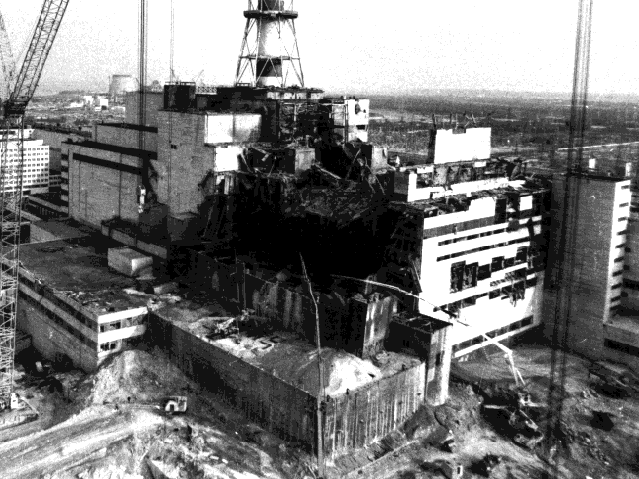 A restricted number, of the order of 400, including plant staff, firemen and medical aid personnel, were on the site during the accident and its immediate aftermath and received very high doses from a variety of sources and exposure pathways. Among them were all those who developed acute radiation syndrome and required emergency medical treatment. The doses to these people ranged from a few grays to well above 10 grays to the whole body from external irradiation and comparable or even higher internal doses, in particular to the thyroid, from incorporation of radionuclides. A number of scientists, who periodically performed technical actions inside the destroyed reactor area during several years, accumulated over time doses of similar magnitude.
The Chernobyl nuclear power plant
The largest group of liquidators participated in clean-up operations for variable durations over a number of years after the accident. Although they were not operating anymore in emergency conditions and were submitted to controls and dose limitations, they received significant doses ranging from tens to hundreds of millisieverts.
Dispersion and deposition of radionuclides
The release of radioactive materials to the atmosphere consisted of gases, aerosols and finely fragmented nuclear fuel particles. This release was extremely high in quantity, involving a large fraction of the radioactive product inventory existing in the reactor, and its duration was unexpectedly long, lasting for more than a week. This duration and the high altitude (about 1 km) reached by the release were largely due to the graphite fire which was very difficult to extinguish. For these reasons and the concomitant frequent changes of wind direction during the release period, the area affected by the radioactive plume and the consequent deposition of radioactive substances on the ground was extremely large, encompassing the whole Northern hemisphere, although significant contamination outside the former Soviet Union was only experienced in part of Europe. The pattern of contamination on the ground and in foodchains was, however, very uneven in some areas due to the influence of rainfall during the pas
sage of the plume. This irregularity in the pattern of deposition was particularly pronounced at larger distances from the reactor site.
Within seven months of the accident, the destroyed reactor was encased in a massive concrete structure, known as the "sarcophagus", to provide some form of confinement of the damaged nuclear fuel and destroyed equipment and reduce the likelihood of further releases of radioactivity to the environment. This structure was, however, not conceived as a permanent containment but rather as a provisional barrier pending the definition of a more radical solution for the elimination of the destroyed reactor and the safe disposal of the highly radioactive materials. Nine years after its erection, the sarcophagus structure, although still generally sound, raises concerns for its long-term resistance and represents a standing potential risk. In particular, the roof of the structure presented for a long time numerous cracks with consequent impairment of leaktightness and penetration of large quantities of rainwater, which is now highly radioactive. This also creates conditions of high humidity producing corrosion of me
tallic structures that contribute to the support of the sarcophagus.
Conclusion
The history of the modern industrial world has been affected on many occasions by catastrophes comparable or even more severe than the Chernobyl accident. Nevertheless, this accident, due not only to its severity but especially to the presence of ionising radiation, had a significant impact on human society.
Not only it produced severe health consequences and physical, industrial and economic damage in the short term, but, also, its long-term consequences in terms of socio-economic disruption, psychological stress and damaged image of nuclear energy, are expected to be long standing.
Average doses to the thyroid gland and collective thyroid doses to the evacuees from Pripyat (Go95a).
|
Year of birth |
Number of
people |
Average individual
dose (Sv) |
Collective dose
(person-Sv) |
|
1983 - 1986 |
2,400 |
1.4 |
3,300 |
|
1971 - 1982 |
8,100 |
0.3 |
2,400 |
|
< = 1970 |
38,900 |
0.07 |
2,600 |
Assessments of the doses to the thyroid gland of the evacuees from the 30-km zone (Li93a) showed similar doses for young children as those for the Pripyat evacuees. Exposures to adults were higher. These high doses were due to a greater consumption of food contaminated with iodine-131 among those evacuated later from the 30-km zone.
Because of the high filtering characteristics of trees, deposition was often higher in forests than in agricultural areas. When contaminated, the specific ecological pathways in forests often result in enhanced retention of contaminating radionuclides. The high organic content and stability of the forest floor soil increases the soil-to-plant transfer of radionuclides with the result that lichens, mosses and mushrooms often exhibit high concentrations of radionuclides. The transfer of radionuclides to wild game in this environment could pose an unacceptable exposure for some individuals heavily dependent on game as a food source. This became evident in Scandinavia where reindeer meat had to be controlled. In other areas, mushrooms became severely contaminated with radiocaesium. In 1990, forest workers in Ukraine were estimated to have received a dose up to three times higher than others living in the same area. In addition, some forest-based industries, such as pulp production which often recycle chemicals
, have been shown to be a potential radiation protection problem due to enhancement of radionuclides in liquors, sludges and ashes. However, harvesting trees for pulp production may be a viable strategy for decontaminating forests. Different strategies have been developed for combating forest contamination. Some of the more effective include restriction of access and the prevention of forest fires. An area of about 375 ha was severely contaminated and in 1987 remedial measures were undertaken to reduce the land contamination and prevent the dispersion of radionuclides through forest fires. The top 10-15 cm of soil was removed and dead trees were cut down. This waste was placed in trenches and covered with a layer of sand. A total volume of about 100,000 m3 was buried, reducing the soil contamination by at least a factor of ten.
These measures, combined with other fire prevention strategies, have significantly reduced the probability of dispersion of radionuclides by forest fires. The chemical treatment of soil to minimise radionuclide uptake in plants may be a viable option and, as has been seen, the processing of contaminated timber into less contaminated products can be effective, provided that measures are taken to monitor the by-products.
Changes in forest management and use can also be effective in reducing dose. Prohibition or restriction of food collection and control of hunting can protect those who habitually consume large quantities. Dust suppression measures, such as re-forestation and the sowing of grasses, have also been undertaken on a wide scale to prevent the spread of existing soil contamination.
Water bodies
In an accident, radionuclides contaminate bodies of water not only directly from deposition from the air and discharge as effluent, but also indirectly by washout from the catchment basin. Radionuclides contaminating large bodies of water are quickly redistributed and tend to accumulate in bottom sediments, benthos, aquatic plants and fish. The main pathways of potential human exposure may be directly through contamination of drinking water, or indirectly from the use of water for irrigation and the consumption of contaminated fish. As contaminating radionuclides tend to disappear from water quickly, it is only in the initial fallout phase and in the very late phase, when the contamination washed out from the catchment area reaches drinking water supplies, that human exposure is likely. In the early phase of the Chernobyl accident, the aquaeous component of the individual and collective doses from water bodies was estimated not to exceed 1-2 per cent of the total exposure.
Today there is an urgent need to work out a concept, and later a national program of a permanent and step to step educational process backed up by appropriate methods and a legal mechanism of procuring funds for supporting it. Unfortunately, the State national program "Osvita" (Education) adopted in 1993 is not regarding these problems as ones of priority. A present task is to adopt a set of regulations and methods that would not only be declaring the willingness of the state to cope the problem and the recognition of the right of the people to obtain ecological education, but would foresee a mechanism for implementing this right.
Destroying of ozone layer is a serious problem for today. Kiev has received about 23 million dollars from World Trust Fund for termination of usage ozone blasting substances. The reconstruction of about ten factories, in main on production of refrigeration cabinets is planed.
My third priority is "Health". Ukraine occupies the first place in the world by quantity of the patients an AIDS disease. Only in Odessa's region officially registered about 8362 HIV infected.
As of 15 December 1995, 1 291 810 cumulative AIDS cases in adults and children have been reported to the World Health Organisation Global Programme on AIDS from 193 countries.
This represents a 26% increase from the 1 025 073 cases reported in the 3 January 1995 Update (and in the Weekly Epidemiological Record of 13 January 1995).
The accompanying tables provide, by country and WHO Region, the number of reported AIDS cases to date, by year of diagnosis.
In January 1995, WHO estimated that there were 13-15 million HIV-infected adults alive as of late 1994 (Weekly Epidemiological Record, No. 2, 13 January 1995). In 1995, following a country-by-country review of HIV/AIDS data, WHO revised its estimate of 1994 adult HIV prevalence to 16.9 million (see "Provisional Working Estimates of Adult HIV Prevalence as of end 1994 by Country", attached, and in the Weekly Epidemiological Record, 15 December 1995). Based on these revised prevalence estimates, and allowing for under- diagnosis, incomplete reporting, and reporting delay, WHO
provisionally estimates that 6 million adult and paediatric cumulative AIDS cases have occurred as of late 1995 (see Figure 1 for reported and estimated AIDS cases). As new data have been incorporated, and a more detailed estimation has been made, this estimate should not be compared with previously published estimates of cumulative AIDS cases. Following a country-by-country review of HIV/AIDS data, the
World Health Organization estimates that globally approximately 17 million adults were living with HIV infection at the end of 1994. The majorities (66%) of these infections were in sub-Saharan Africa (11.2 million) followed by South and Southeast Asia (3 million) with Australasia having the fewest infections (12 000). In 50 countries the estimated HIV prevalence rate was less than 5 per 10 000 sexually active
adults and in 15 countries (all in sub-Saharan Africa) the prevalence rate was over 500 per 10 000. The lowest prevalence rates were seen in Central and East Asia and the highest in Central and Southern Africa. Between 1995 and 1999 amount of HIV infected increased almost in a half.
Breast cancer is the most common type of cancer in women, with approximately one in nine women developing the disease in her lifetime. Although breast cancer is known to affect women, it also can be equally devastating to men. Male breast cancer accounts for 1% of all diagnosed breast cancer. Breast cancer is a disease in which cancerous cells are found in the tissues of the breast. These cancerous cells continue to grow and eventually form into a lump known as a tumor.
Although more than 80% of breast lumps are not cancerous, a process known as a biopsy is the only way to know for sure. A biopsy requires the doctor to remove a small sample of tissue and examine it under a microscope and check for cancerous cells.
For the last year in Ukraine were revealed about 17000 women with a breast cancer. Breast Cancer affects more American women than any other type of cancer. There were about 100,000 new cases diagnosed in 1985, and in 1994, over 180,000 new cases were confirmed. One reason given to this dramatic rise is that more women are receiving diagnostic tests for breast cancer. However, other reasons for the long-term increase in breast cancer are not yet fully understood. In 1994, a gene was located and sequenced that has been shown to be changed in 5% of the 180,000 breast cancer patients. Relatives of breast cancer patients who carry this modified gene have a higher rate of developing breast cancer in their lives. Tests are being developed to determine who has this gene long before any cancer appears. Even with these tests, scientists still do not have a way of directly treating the defective genes. Although researchers are investigating the possible roles of heredity, environment, lifestyles, and diet, it's still
not clear what causes most breast cancer or how to prevent it.
According to a media resource in Japan, an outbreak of hepatitis A began last month on the Russian Far East Island of Sakhalin, which at the peak of the epidemic hospitalized 430 persons. Out of 5900 persons examined, 4500 were given vaccine.
Major harm to human organism brings drugs and smoking.
The statistics is awful. The state of an environment affects on human's health and the state of environment depends on human's activity. That's why, I think Peace, Environment and Health - are the most important priorities for today.
"Human rights" I have put on the fourth place, because I worry about "Children rights". Laws were written by the adults and for the adults. Nobody took into account interests of children. Only kids can decide what they need. Many children can not get a full-fledged education. But without the educated population impossible a process of development of civilizations. Poor children frequently can not afford complete education. Therefore priorities "Poverty" and "Education" also are interdependent with each other. The theme "Corruption" is very close to the Ukrainian people. Pavel Lazarenco is the most known political figure, which was accused of assignment of state property. We require new young politics, which will put by the purpose augmentation of well being of the native country.
Actually, I don't think that "Travel & tourism" is a global problem. It concerns only developed countries, in which arrive many tourists. Ukraine doesn't pertain to them.
I want to visit the Congress, because I want to change the surrounding world.
REPORT
on theme:
The Most Important Priorities
by Juliya Berzoy
ODESSA-1999